
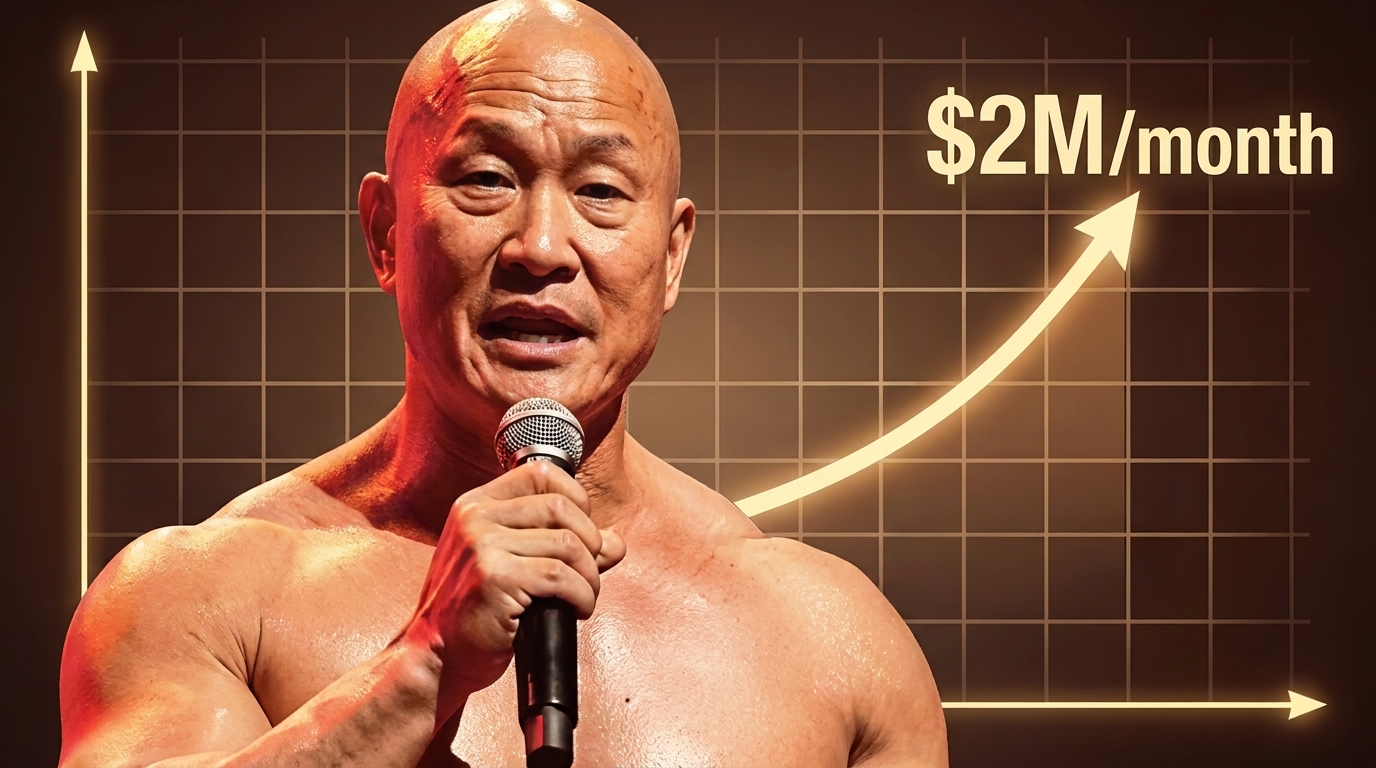
A Sales Funnel template Reverse-Engineered from a $2M/Month AI Ad Campaign
Most sales funnel template are theoretical. This one is different. It’s reverse-engineered from a real AI-powered video ad campaign generating over $2 million per month — for a Tai Chi fitness program — built with almost zero production cost. Here’s how the entire funnel works, and how to clone it for your own business.

What is a sales funnel template?
A sales funnel template is a repeatable, step-by-step structure that moves a cold stranger from first contact to paying customer. The best templates aren’t built in a boardroom — they’re extracted from campaigns that are already winning at scale.
The funnel we’re analyzing does exactly this. It uses AI-generated video ads, a psychological hook, a quiz funnel, and a personalized email sequence to convert viewers into buyers — automatically, 24/7.
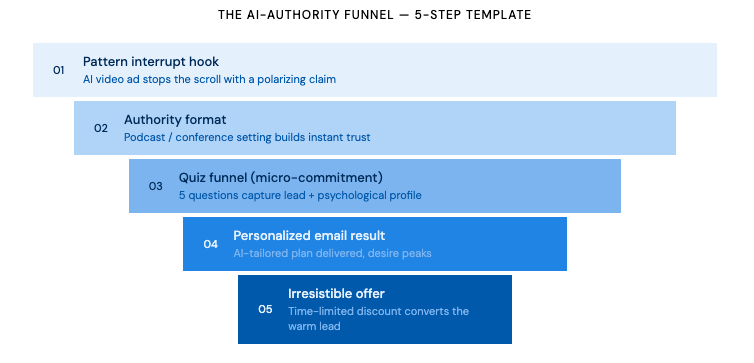
Step 1 — The polarizing hook (pattern interrupt)
The ad opens with a bold, counterintuitive statement: “Running breaks your joints. Tai Chi builds them back.” This is not an accident. It’s a deliberate use of what copywriters call a pattern interrupt — a claim that attacks a common belief, forcing the viewer to stop scrolling to process the contradiction.
The hook formula: [Common healthy habit] + [Hidden negative consequence] + [Your alternative solution].
Example for another niche: “Counting calories slows your metabolism. Here’s what actually works.”
The ad also targets a very specific audience — men and women over 50 — and immediately promises a tiered timeline of results: energy in 1 week, better breathing in 2 weeks, visible changes in 3 weeks. This specificity is what separates good copy from great copy: the more precise the promise, the more believable it becomes.
Step 2 — The authority format (AI-generated video)
The visual format is doing heavy psychological lifting. The AI-generated actor is not a generic fitness model. He’s 50+, muscular, and aspirational — the avatar the target audience wants to become, not a reminder of who they currently are.
Midway through the ad, the format shifts to a podcast-style interview. This is a masterclass in reducing sales resistance. Podcast format signals authenticity and expertise. The viewer stops perceiving a sales pitch and starts listening to an “expert conversation.” The host plays devil’s advocate — raising every objection the viewer might have — and the expert neutralizes each one in real time.
Key objection handling used in the script:
“What if they haven’t exercised in years?” → “That’s actually ideal.”
“Do they need equipment?” → “No. Just 7 minutes a day.”
Every objection removed before it forms.
The entire video is AI-generated — no studio, no crew, no actors. A small disclaimer reads “AI-generated actor. Experimental user experience.” This transparency is both ethically sound and strategically smart on most ad platforms.
Step 3 — The quiz funnel (micro-commitment engine)
The ad doesn’t send viewers to a sales page. It sends them to a quiz. This is the highest-leverage component of the entire sales funnel template.
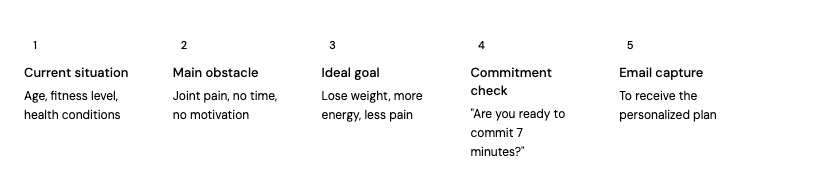
Current situation
Age, fitness level, health conditions
Main obstacle
Joint pain, no time, no motivation
Ideal goal
Lose weight, more energy, less pain
Commitment check
“Are you ready to commit 7 minutes?”
Email capture
To receive the personalized plan
Why does this work so well? Because of the micro-commitment principle: once a person has answered 5 questions, they are psychologically invested. They want to see their result. The drop-off rate at the email field plummets because quitting now would waste the effort already made.
The quiz also creates what marketers call the Barnum effect — the perception that the result was designed specifically for you. The lead receives an email that references their exact answers, making the offer feel custom-built rather than mass-produced.
Step 4 — The personalized email sequence
The quiz result email delivers a free plan (the “what”) and immediately presents a paid upgrade (the “how”). The structure is simple but highly effective:
Because the email list is now segmented by quiz answers, follow-up sequences can be fully personalized. Someone who said their main obstacle is joint pain gets a different email series than someone who said lack of time — even if they purchased the same product.
Step 5 — Why this sales funnel template is infinitely scalable
The entire structure described above can be replicated for virtually any niche. The real competitive advantage isn’t the Tai Chi program — it’s the system.
How to implement this sales funnel template for your business
You don’t need a $2M budget to start. You need a systematic approach. Here’s the minimum viable version:
The AI-Authority Funnel — quick-start checklist:
1. Write your polarizing hook using the formula above
2. Generate an AI video using tools like HeyGen, Synthesia, or Kling
3. Build a 5-question quiz using Typeform, ScoreApp, or TryInteract
4. Set up an email sequence in ConvertKit or ActiveCampaign (3–5 emails)
5. Connect your offer with a discount code that expires in 48 hours
The psychology doesn’t change with the niche. Whether you’re selling a fitness program, a business coaching community, an online course, or a SaaS tool — the sequence remains: interrupt → trust → invest → personalize → convert.
Key takeaways
The best sales funnel template isn’t theoretical — it’s already running and generating results at scale. What this campaign proves is that AI has permanently changed the economics of direct response marketing. The barrier to entry has collapsed. The psychological principles that drive conversions have not.
Identify a real pain point, present a credible solution, build trust through format before selling through copy, capture data through micro-commitment, and close with personalization and urgency. That’s the template. Now the only question is which niche you’ll apply it to first.
Want to see the full framework broken down step by step?
Leave a Reply